
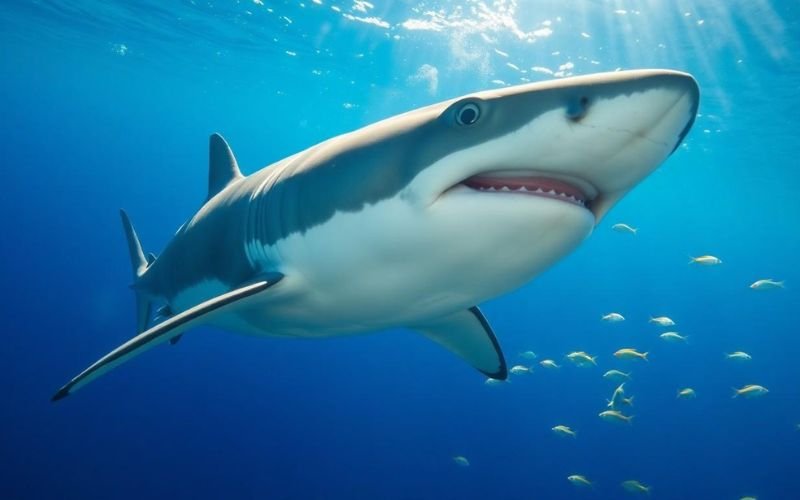
Yes, sharks can smell blood, and they do it better than almost any other predator in the ocean. Ask most people how a shark finds its next meal, and blood is usually the first thing that comes to mind. Movies love the idea of a single drop turning calm water into a feeding frenzy.
The real story is less cinematic but arguably more impressive. Sharks rely on one of the most sensitive smelling systems in the animal kingdom, shaped by millions of years of evolution to pick up the faintest trace of a chemical signal in water. Below, we’ll break down how a shark’s nose actually works, sharks can smell blood from how far away in real conditions, and which popular claims are simply myths.
How Do Sharks Smell?
The Nose That Never Breathes
A shark’s nostrils, called nares, have nothing to do with breathing. Sharks pull oxygen from water through their gills, so their nares exist purely to smell. Water flows in one side of each nare, passes over folds of tissue called olfactory lamellae, and exits the other side, carrying scent molecules across thousands of sensory cells along the way.
Those sensory cells feed directly into the olfactory bulbs, the part of the brain that processes smell. In great white sharks, researchers have found that olfactory bulbs make up roughly 14 percent of total brain mass, among the highest proportions recorded in any cartilaginous fish. Scalloped hammerhead sharks come in around 7 percent, compared to about 3 percent in many other shark families.
Stereo Smelling: Two Nostrils, One Direction
Because a shark’s nares sit apart from each other, the shark can compare which nostril picks up a scent first and how strong it is on each side. This is called bilateral or stereo olfaction, and it works much like how two ears help you figure out where a sound is coming from. Hammerheads take this to an extreme: their widely spaced nares, set at the tips of that unusual hammer-shaped head, give them an especially precise sense of direction when tracking a scent trail.
Can Sharks Smell Blood? What the Science Shows

So, can sharks smell blood specifically, or just food-related scents in general? Both. Blood contains amino acids and other compounds that sharks are highly tuned to detect, but it’s not the only thing that grabs their attention. Fish extracts, body fluids, and even chemical cues from injured prey can trigger the same response.
A few well-documented facts about shark smell:
- Sharks can detect certain scent molecules at concentrations between roughly 1 part per 25 million and 1 part per 10 billion, depending on the species and the specific chemical involved.
- At the more sensitive end, that’s comparable to detecting a single drop of a substance diluted across a small swimming pool.
- Detection isn’t instant recognition of “blood” the way humans identify a smell; sharks respond to specific chemical compounds, then use bilateral smelling to swim toward the source.
- Not all shark species are equally sensitive. Hammerheads and lemon sharks, both studied extensively by marine researchers, show particularly strong scent-tracking abilities.
How Far Can Sharks Smell Blood?

This is where the myths really take over. Under strong current conditions, with a real scent plume from something like a bleeding fish, sharks can pick up and follow a scent trail from roughly a quarter mile away, around 400 meters. That’s genuinely impressive, but it’s a far cry from the popular claim that sharks can smell a single drop of blood from a mile out.
| Factor | Approximate Range |
| Scent concentration a shark can detect | 1 part per 25 million to 1 part per 10 billion (species and chemical dependent) |
| Maximum tracking distance in a strong current | Up to about a quarter mile (400 meters) |
| Great white shark olfactory bulb size | Roughly 14 percent of total brain mass |
| Hammerhead shark olfactory bulb size | Roughly 7 percent of total brain mass |
| Other shark families’ olfactory bulb size | Roughly 3 percent of total brain mass |
Distance always depends on water movement. A calm, current-free area disperses scent slowly and unpredictably, while a moving current can carry a scent plume much farther in a narrow, traceable line. Without a current pushing the scent toward a shark, the animal may never encounter it at all, even at close range.
Shark Smell vs. Human Smell
| Trait | Human | Shark |
| Detects scent molecules dissolved in water | Poor, adapted for air | Excellent, adapted for water |
| Uses two nostrils to judge scent direction | Very limited | Highly developed (stereo olfaction) |
| Relies on smell to locate food at a distance | Rarely | Frequently, especially at close to medium range |
| Portion of brain devoted to smell | A small fraction | Up to around 14 to 18 percent in some species |
Common Myths About Sharks and Blood
Sharks have a reputation problem, and blood is at the center of most of it. Here are the claims worth retiring:
- Myth: Sharks can smell a drop of blood from a mile away. In reality, detection tops out around a quarter mile under favorable current conditions, not a full mile.
- Myth: Any blood in the water triggers a feeding frenzy. Sharks investigate scent trails methodically. A true frenzy is a rare, specific behavior tied to large amounts of food, not a single scent cue.
- Myth: Menstrual blood is especially attractive to sharks. There’s no credible scientific evidence supporting this claim. Sharks respond to specific amino acids and chemical compounds found broadly in blood and body fluids, not to menstrual blood in particular.
- Myth: Smell is the only sense sharks use to hunt. Smell gets sharks into the general area, but other senses take over from there.
Beyond Smell: How Sharks Really Track Prey
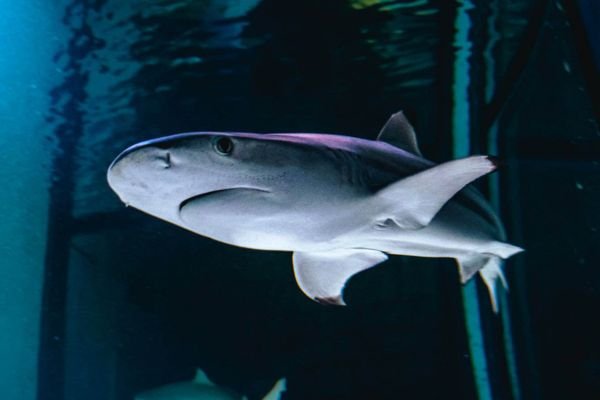
Smell is just the opening move. Once a shark gets closer, other senses take over:
- Ampullae of Lorenzini: Jelly-filled pores on a shark’s snout that detect tiny electrical fields produced by muscle movement, useful even when prey is hidden under sand.
- Lateral line: A row of sensory cells running along the body that picks up vibrations and pressure changes from nearby movement in the water.
- Hearing: Sharks can detect low-frequency sounds, like the erratic splashing of an injured fish, from considerable distances.
- Vision: At close range, sharks use eyesight to confirm what they’ve been tracking before making contact.
Marine biologists who study shark sensory systems, including researchers at institutions like Woods Hole Oceanographic Institution, describe this as a layered system: smell narrows the search area, and electroreception, hearing, and vision handle the final approach.
Conclusion
So, can sharks smell blood? Absolutely, and their olfactory system ranks among the most refined in the animal kingdom. But the real science is more nuanced than the “mile away” myth suggests. Detection distance depends heavily on current, concentration, and species, typically topping out around a quarter mile rather than the exaggerated numbers found in popular folklore. Smell gets a shark’s attention, but electroreception, hearing, and vision do the rest of the work once it closes in.